
Ol Pejeta Conservancy
The Ol Pejeta Conservancy is a 360 km2 (140 sq mi) not-for-profit wildlife conservancy in Central Kenya’s Laikipia County. It is situated on the equator west of Nanyuki, between the foothills of the Aberdares and Mount Kenya. The Ol Pejeta Conservancy works to conserve wildlife, provide a sanctuary for great apes, and generate income through wildlife tourism and complementary enterprises for re-investment in conservation and community development.
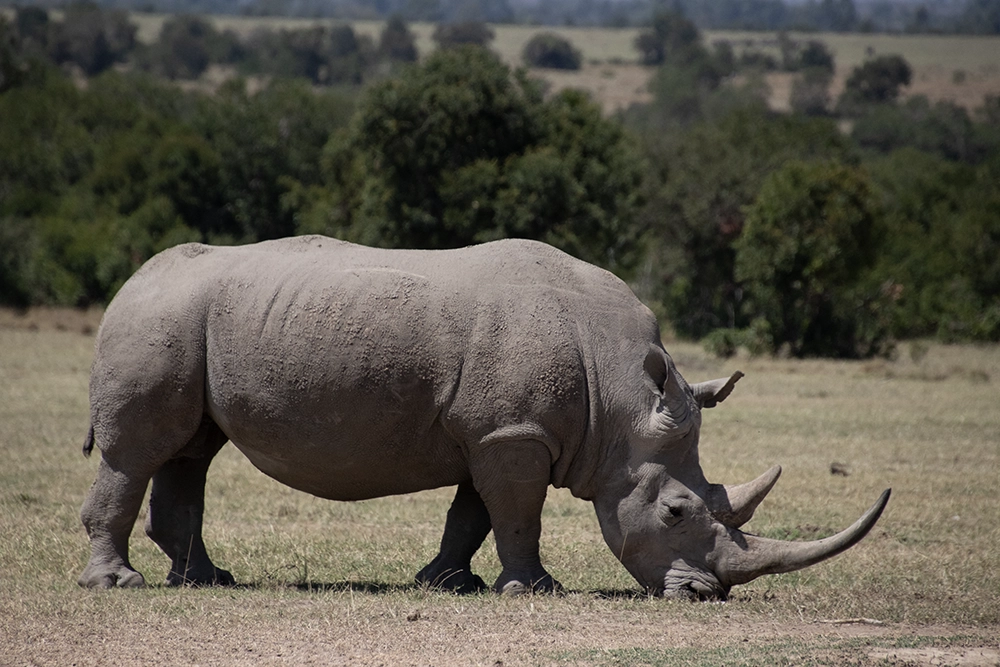
The Conservancy boasts the largest black rhinoceros sanctuary in East Africa; in 2013, it reached a population milestone of one hundred eastern black rhinos. It also houses the two remaining northern white rhinos in the world, who were moved there from Dvůr Králové Zoo in the Czech Republic. The Sweetwaters Chimpanzee Sanctuary is situated here which provides a haven for orphaned, abandoned, and rescued chimpanzees. It is the only place in Kenya where chimpanzees can be seen. The Conservancy is host to the “Big five game” animals among a large selection of other African animals, which makes it a notable safari destination. It also operates a livestock program that serves to benefit local pastoralists and wildlife. Through the conservancy’s community development program, Ol Pejeta provides funding to surrounding communities to aid health, education, water and infrastructure projects. They also support the provision of agriculture and livestock extension services and the development of community-based conservation tourism ventures.
During the colonial era, the Laikipia Plateau was used as an extensive cattle ranching area. Lacking the rainfall required to farm crops, cattle ranching was adopted as the next best way to utilize the land.
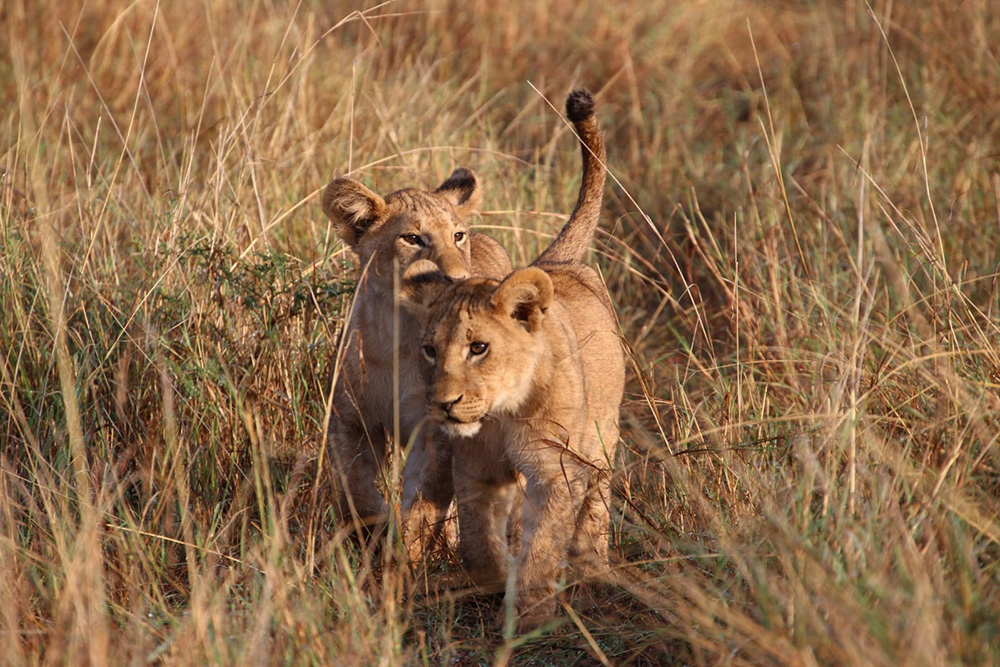
Lion Cubs in Olpajeta Conservancy
John and Jane Kenyon took over the management of Ol Pejeta in 1949 when it was owned by Lord Delamere and together they spent the next 15 years developing the ranch. When the Kenyons first took on Ol Pejeta, they were joined by Delemere’s school friend and business partner Marcus Wickham Boynton. Together they organised the then 230 km2 (57,000-acre) ranch into a successful beef-producing company. Over the next few years, they expanded the farm to cover an estimated 360 km2 (90,000 acres). The Kenyons left Ol Pejeta for a year in 1958, then returned for a further ten years, before finally retiring to run their own cattle ranch to the north. Since then, the ranch has had a number of owners, including Marcus Wickham Boynton and Adnan Khashoggi, a billionaire arms dealer and businessman considered one of the richest men in the world in the early 1980s.
Over time, cattle ranching became less profitable. Elephant populations, which previously used the ranch as a transit area from the north to Mount Kenya and the Aberdares, increasingly took up permanent residence on the property. As a result, fences required to maximise cattle productivity were destroyed and became impossible to maintain cost-effectively. In the face of declining wildlife populations elsewhere and to effectively utilize the land, the land has seen an increasing emphasis placed upon wildlife conservation.
In 2004, the ranch and surrounding land were purchased by the UK-based conservation organisation Fauna and Flora International (FFI) with the financial backing of the Arcus Foundation, a private international philanthropic organization founded by Jon Stryker. The land purchase was wholly funded by a $15 million donation from the Arcus Foundation, which worked in tandem with FFI and the Lewa Wildlife Conservancy to secure the 360 km2 (90,000 acres) of open savannah grassland and convert it to a national land trust. The Arcus Foundation also gave $12 million to fund capital and institutional development costs at the conservancy, which allowed Ol Pejeta Conservancy to operate as a Kenyan-owned operation benefiting local community development and economic growth.
All members of the “Big five game” (lion, Cape buffalo, African bush elephant, African leopard and rhinoceros) can be found on the Ol Pejeta Conservancy. Both black and white rhino thrive here. In 2013, Ol Pejeta recorded the birth of its 100th black rhino. This means the Conservancy is now a “Key 1” black rhino population on the IUCN African Rhino Specialist Group categorization. It is one of only eight sanctuaries in Africa with this distinction.
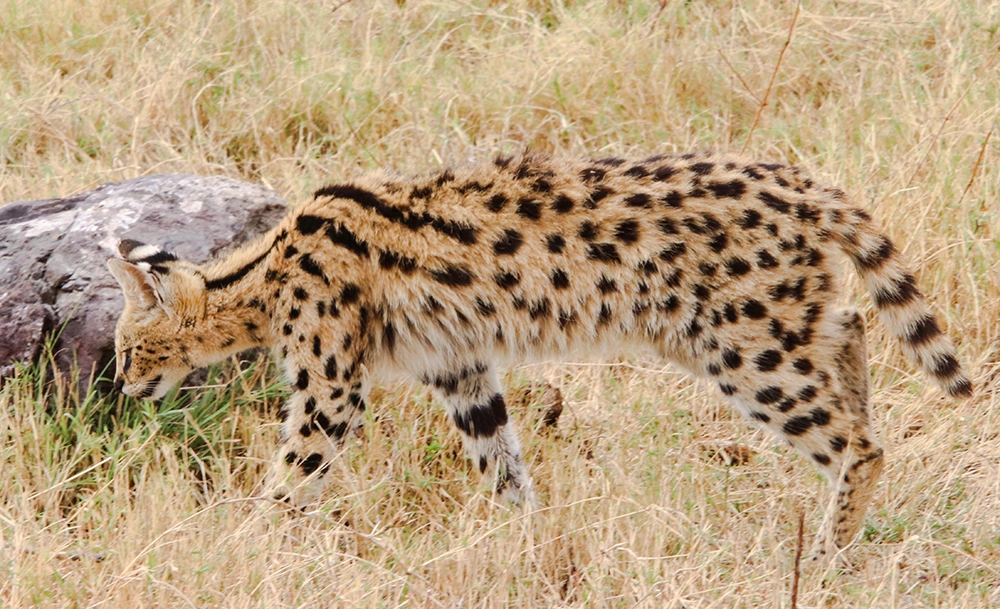
Serval Cat Olpajeta Conservancy
Other rare animals that can be found on Ol Pejeta include the endangered African wild dog, oryx, Jackson’s hartebeest, Grevy’s zebra, serval, cheetah and bat-eared fox. The more common African wildlife can be found too, including giraffes, vervet monkeys, baboons, hippos, impala, eland, Grant’s gazelle, dik-dik, plains zebra, silver backed jackal, hyena. There are also over 300 bird species on the Conservancy.
All animals are free to move in and out of the Conservancy by way of specially constructed game corridors that only restrict the movement of rhinos. Knee-high posts in the ground, situated very close together, present no challenge for elephant, antelope, and carnivores, who are easily able to jump or step over. Rhinos, however, are unable to do this, and as a result are restricted from moving into areas where they are in danger of being poached for their horn.
The northern white rhino is one of the five rhino species still remaining. Closely resembling its southern white cousin, the northern whites were hit particularly hard in the poaching epidemic of the 1980s and early 90s and it is now considered extinct in the wild. On 20 December 2009 Ol Pejeta became home to four of the then seven rhinos left in captivity. Two males and two females were moved from Dvůr Králové Zoo in the Czech Republic in the hope that the climate and rich grasslands of Ol Pejeta, a native habitat for the animals, would provide them with more favorable breeding conditions.
The males (named Sudan and Suni) and the females (Fatu and Najin) enjoyed 24-hour armed security and a 700-acre enclosure. Suni was seen mating with Najin in 2012, but tests have confirmed she is not pregnant. Ol Pejeta is trying to cross-breed the closely related southern white rhinos with the northern whites to preserve northern white rhino genetics in hybrid offspring. On 17 October 2014 Suni died from unknown causes but not because of poaching. On 19 March 2018 Sudan was euthanized after suffering from “age-related complications”.
The trade in rhino horn and ivory is so lucrative that increasingly, poachers are gaining access to automatic weapons, silencers, and night-vision to carry out their work. Protecting wildlife from these criminals is an expensive business. Convention has it that the cost of protecting wildlife habitat doubles with the presence of black rhino.
A team of 14 dogs and their handlers assist in several areas of Ol Pejeta Conservancy security. The bloodhounds are trained to track human scent and are often the first on the scene at any incidents. The Belgian Malinois dogs, recently acquired by Conservancy, have been trained in tracking, attack, patrol, ivory detection, and weapons detection.
In 2013, the Ol Pejeta Conservancy started to use a drone with the capacity to deliver real time video and thermal imaging feeds to a team on the ground. Deployed in a poaching incident, this drone will have the capability to help armed teams on the ground, to record video for use in court, and to help undertake a census of the reserve.
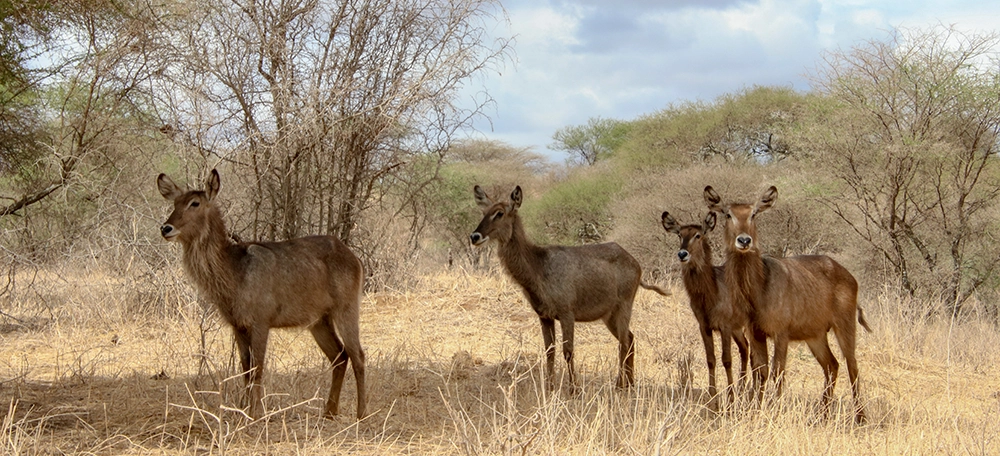
Waterbucks Olpajeta Conservancy
The Conservancy operates several armed teams. These are self-sufficient, mobile teams able to spend extended periods of time in the field. These teams have been trained to operate day and night and to respond to incidents, not only within the Ol Pejeta Conservancy, but also in conjunction with local authorities outside of the Conservancy.
There is a coverage rate of one rhino patrol team to 14 square kilometers (1,400 ha) within the core conservation area of Ol Pejeta. The patrol teams’ key objective is to monitor the black rhino, but their monitoring of the area also benefits other key species within the Conservancy.