The beautiful Kenya destinations are spread out across the Country.
The Gregory rift cuts through the country from the North to south on the western part of the country as the Equator line cuts through the country from the East to west. Several geographical features were formed during the formation of the East Africa Rift system.
Numerous stratovolcano mountains were formed alongside lakes along the system. These are also part of the numerous ecosystems in the region that are host to different flora and fauna.
The climate is friendly throughout the year and geographically the country is well located to be home to an abundance of species in the greater country.
1. ABOUT KENYA
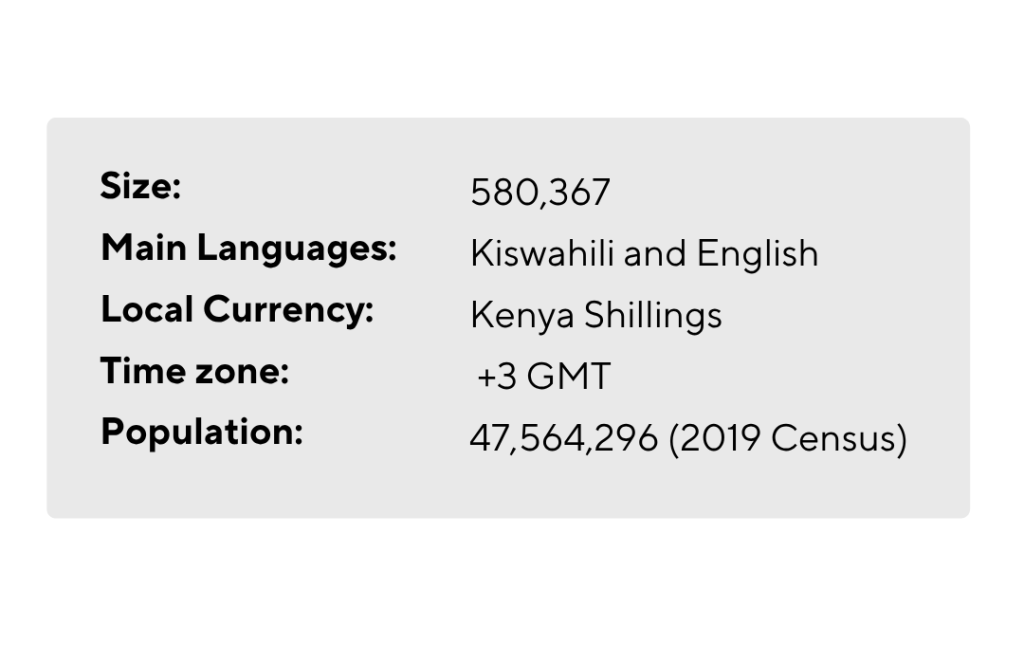
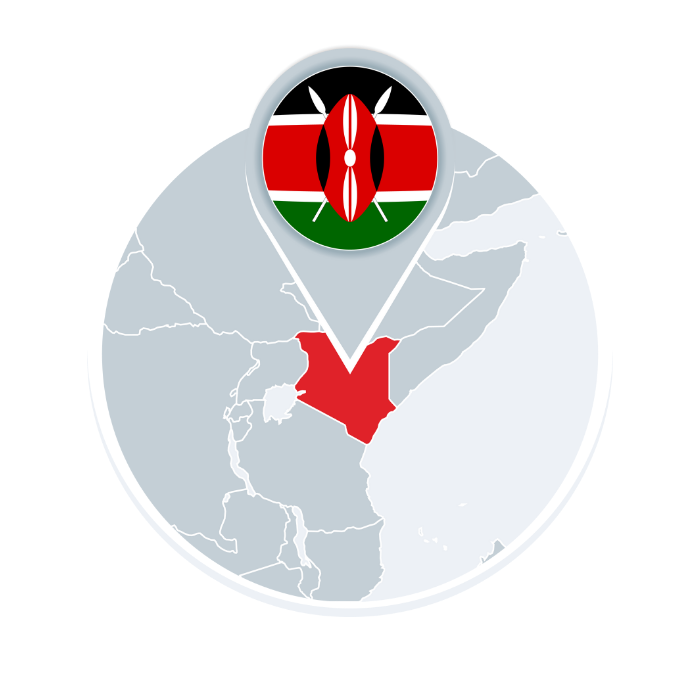
(Swahili: Jamhuri ya Kenya), is a country in East Africa. A member of the African Union with a population of more than 47.6 million in the 2019 census, Kenya is the 28th most populous country in the world and 7th most populous in Africa. Kenya’s capital and largest city is Nairobi, while its oldest and second largest city, which until 1907 was also Kenya’s first capital city, is the major port city of Mombasa which includes Mombasa Island in the Indian Ocean and the surrounding mainland. Other important cities include Kisumu and Nakuru.
Kenya is bordered by South Sudan to the northwest, Ethiopia to the north, Somalia to the east, Uganda to the west, Tanzania to the south, and the Indian Ocean to the southeast. Kenya’s geography, climate and population vary widely, ranging from cold snow-capped mountaintops (Batian, Nelion and Point Lenana on Mount Kenya) with vast surrounding forests, wildlife and fertile agricultural regions to temperate climates in western and rift valley counties and further on to dry less fertile arid and semi-arid areas and absolute deserts (Chalbi Desert and Nyiri Desert).Kenya’s earliest inhabitants were hunter-gatherers, like the present-day Hadza people. According to archaeological dating of associated artifacts and skeletal material, Cushitic speakers first settled in Kenya’s lowlands between 3,200 and 1,300 BC, a phase known as the Lowland Savanna Pastoral Neolithic. Nilotic-speaking pastoralists (ancestral to Kenya’s Nilotic speakers) began migrating from present-day South Sudan into Kenya around 500 BC. Bantu people settled at the coast and the interior between 250 BC and 500 AD.
European contact began in 1500 AD with the Portuguese Empire, and effective colonization of Kenya began in the 19th century during the European exploration of the interior. Modern-day Kenya emerged from a protectorate established by the British Empire in 1895 and the subsequent Kenya Colony, which began in 1920. Numerous disputes between the UK and the colony led to the Mau Mau revolution, which began in 1952, and the declaration of independence in 1963. After independence, Kenya remained a member of the Commonwealth of Nations. The current constitution was adopted in 2010 and replaced the 1963 independence constitution.
Kenya is a presidential representative democratic republic, in which elected officials represent the people and the president is the head of state and government. Kenya is a member of the United Nations, the Commonwealth, World Bank, International Monetary Fund, COMESA, International Criminal Court, as well as other international organizations. With a GNI of 1,840, Kenya is a lower-middle-income economy. Kenya’s economy is the second largest in eastern and central Africa, after Ethiopia, with Nairobi serving as a major regional commercial hub. Agriculture is the largest sector; tea and coffee are traditional cash crops, while fresh flowers are a fast-growing export. The service industry is also a major economic driver, particularly tourism. Kenya is a member of the East African Community trade bloc, though some international trade organizations categorize it as part of the Greater Horn of Africa. Africa is Kenya’s largest export market, followed by the European Union.
The Republic of Kenya is named after Mount Kenya. The earliest recorded version of the modern name was written by German explorer Johann Ludwig Krapf in the 19th century. While traveling with a Kamba caravan led by the long-distance trader Chief Kivoi, Krapf spotted the mountain peak and asked what it was called. Kivoi told him “Kĩ-Nyaa” or “Kĩlĩma- Kĩinyaa”, probably because the pattern of black rock and white snow on its peaks reminded him of the feathers of the male ostrich. In archaic Kikuyu the word ‘nyaga’ or more commonly ‘manyaganyaga’ is used to describe an extremely bright object. The Agikuyu, who inhabit the slopes of Mt. Kenya, call it Kĩrĩma Kĩrĩnyaga (literally ‘the mountain with brightness’) in Kikuyu, while the Embu call it “Kirenyaa”. All three names have the same meaning.
Ludwig Krapf recorded the name as both Kenia and Kegnia. Some have said that this was a precise notation of the African pronunciation. An 1882 map drawn by Joseph Thompsons, a Scottish geologist and naturalist, indicated Mt. Kenya as Mt. Kenia.
At 580,367 km2 (224,081 sq mi) Kenya is the world’s 47th-largest country (after Madagascar). It lies between latitudes 5°N and 5°S, and longitudes 34° and 42°E. From the coast on the Indian Ocean, the low plains rise to central highlands which are bisected by the Great Rift Valley, and fertile plateaus lie on either side, around Lake Victoria and to the east.
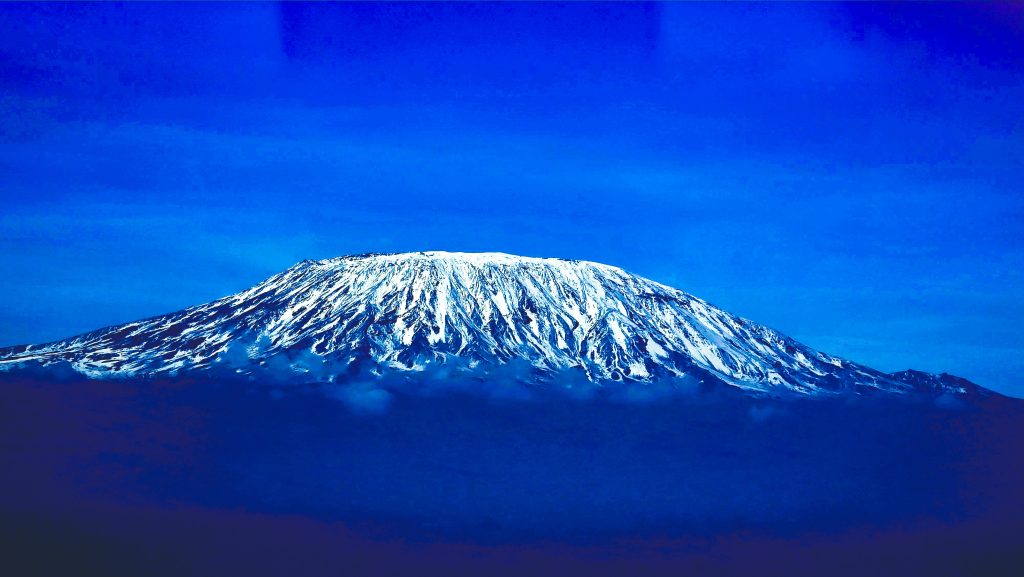
The Kenyan Highlands are one of the most successful agricultural production regions in Africa. The highlands are the site of the highest point in Kenya and the second highest peak on the continent: Mount Kenya, which reaches a height of 5,199 m (17,057 ft) and is the site of glaciers. Mount Kilimanjaro (5,895 m or 19,341 ft) can be seen from Kenya to the south of the Tanzanian border.
Kenya’s climate varies from tropical along the coast to temperate inland to arid in the north and northeast parts of the country. The area receives a great deal of sunshine every month. It is usually cool at night and early in the morning inland at higher elevations.
The “long rains” season occurs from March/April to May/June. The “short rains” season occurs from October to November/December. The rainfall is sometimes heavy and often falls in the afternoons and evenings. Climate change is altering the natural pattern of the rainfall period, causing an extension of the short rains, which has begat floods and reducing the drought cycle from every ten years to annual events, producing strong droughts such as the 2008–09 Kenya Drought.
The temperature remains high throughout these months of tropical rain. The hottest period is February and March, leading into the season of the long rains, and the coldest is in July, until mid-August.
Climate change is posing an increasing threat to global socio-economic development and environmental sustainability. Developing countries with low adaptive capacity and high vulnerability to the phenomenon are disproportionately affected. Climate change in Kenya is increasingly impacting the lives of Kenya’s citizens and the environment Climate Change has led to more frequent extreme weather events like droughts which last longer than usual, irregular and unpredictable rainfall, flooding and increasing temperatures.
The effects of these climatic changes have made already existing challenges with water security, food security and economic growth even more difficult. Harvests and agricultural production which account for about 33% of total Gross Domestic Product (GDP) are also at risk. The increased temperatures, rainfall variability in arid and semi-arid areas, and strong winds associated with tropical cyclones have combined to create favorable conditions for the breeding and migration of pests. An increase in temperature of up to 2.5 °C by 2050 is predicted to increase the frequency of extreme events such as floods and droughts.
Kenya had a population of approximately 48 million in January 2017. The country has a young population, with 73% of residents under 30 because of rapid population growth, from 2.9 million to 40 million inhabitants over the last century.
Nairobi is home to Kibera, one of the world’s largest slums. The shantytown is believed to house between 170,000 and one million people. The UNHCR base in Dadaab in the north houses around 500,000.
Kenya has a diverse population that includes many of Africa’s major ethnoracial and linguistic groups. Although there is no official list of Kenyan ethnic groups, the number of ethnic categories and subcategories recorded in the country’s census has changed significantly over time, expanding from 42 in 1969 to more than 120 in 2019. Most residents are Bantus (60%) or Nilotes (30%) Cushitic groups also form a small ethnic minority, as do Arabs, Indians, and Europeans.
According to the Kenya National Bureau of Statistics (KNBS), in 2019, Kenya had a total population of 47,564,296. The largest native ethnic groups were the Kikuyu (8,148,668), Luhya (6,823,842), Kalenjin (6,358,113), Luo (5,066,966), Kamba (4,663,910), Somali (2,780,502), Kisii (2,703,235), Mijikenda (2,488,691), Meru (1,975,869), Maasai (1,189,522), and Turkana (1,016,174). The Northeastern Province of Kenya, formerly known as NFD, is predominantly inhabited by the indigenous ethnic Somalis. Foreign-rooted populations include Arabs, Asians, and European.
Most Kenyans are Christian (85.5%), with 53.9% Protestant and 20.6% Roman Catholics the Presbyterian Church of East Africa has 3 million followers in Kenya and surrounding countries. There are smaller conservative Reformed churches, the Africa Evangelical Presbyterian Church, the Independent Presbyterian Church in Kenya, and the Reformed Church of East Africa. Orthodox Christianity has 621,200 adherents Kenya has by far the highest number of Quakers of any country in the world, with around 146,300. The only Jewish synagogue in the country is in Nairobi.
1. KENYAN DESTINATIONS


3. KENYAN ITINERARIES